Why Your Website Isn't Getting Cited by AI Answer Engines

We keep getting the same kind of request lately. A business wants to show up when someone asks ChatGPT or Perplexity a question in their industry. They have heard the term AEO, Answer Engine Optimization, and they want in.
Then we look at the website. Title tags are missing or duplicated. There is no schema markup. Nobody is named as the author of anything. Half the blog is three years old and reads like a different company wrote it.
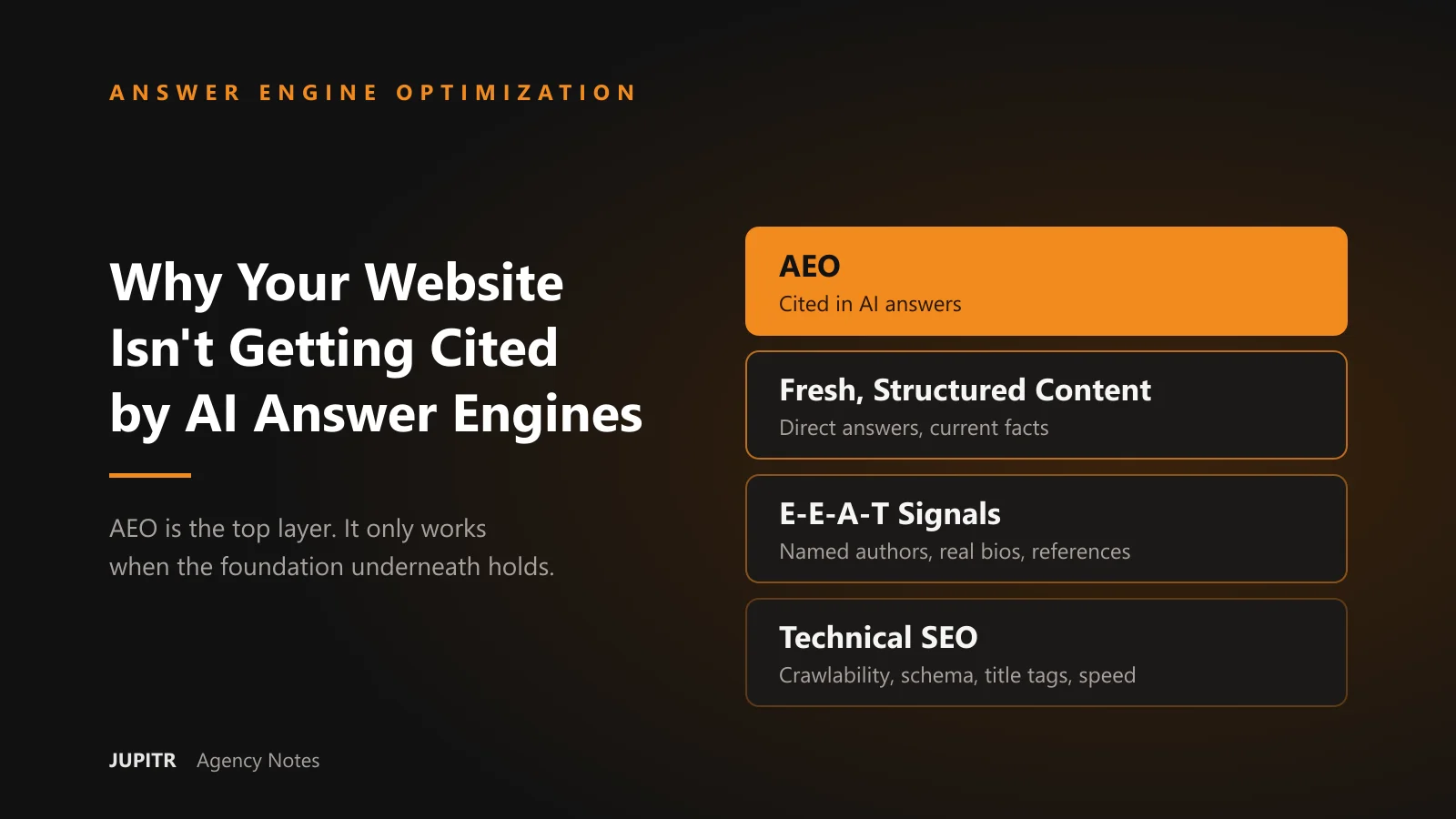
Answer Engine Optimization does not work as a shortcut around a shaky foundation. It works as the next layer built on top of one. If the foundation is not there yet, that is where we start.
What Is AEO, and How Is It Different From SEO?
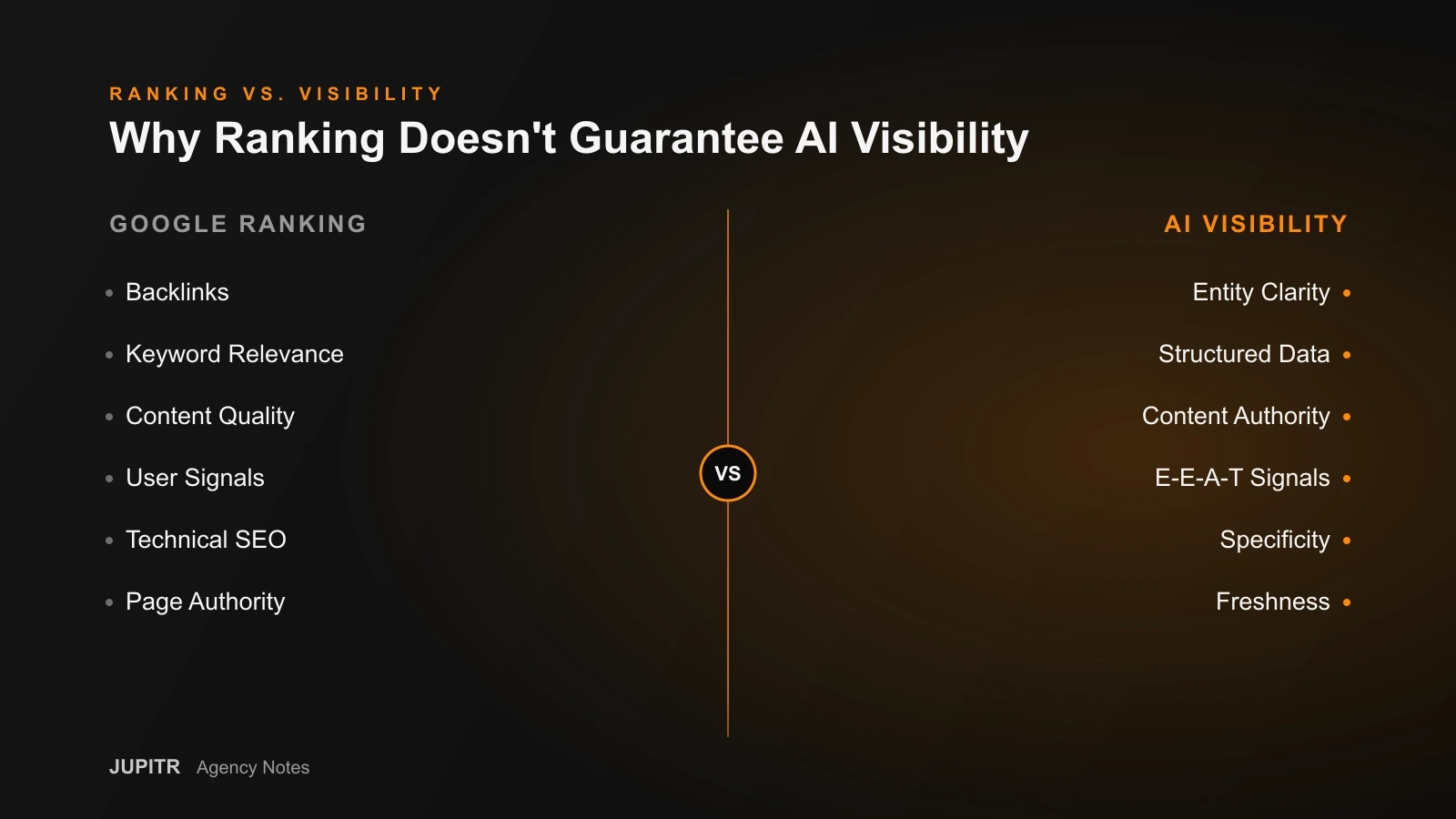
SEO is about getting your page to rank in a list of search results. AEO is about becoming the source an AI system pulls from when it writes the answer itself, in tools like ChatGPT, Perplexity, or Google's AI Overviews.
The mechanics are more similar than people expect. These systems still crawl the web. They still weigh many of the same signals search engines have used for years, things like site structure, content quality, and how trustworthy a source looks. What changed is the output. Instead of ten blue links, the reader gets one synthesized answer, and your site is either part of what shaped that answer or it is invisible to it.
Why Do So Many Businesses Skip the Technical Basics?
This is the pattern we see most. A client wants AEO results but the basic technical SEO underneath it was never done properly. No clean site structure. No schema markup telling engines what type of content they are looking at. Slow load times. Broken links. Title tags that are missing, duplicated, or stuffed with keywords instead of written for a person.
AEO does not replace this work. It sits on top of it. If a crawler cannot properly access and parse your site, it has nothing to extract and nothing to cite, no matter how good the writing underneath is.
The good news is that this part is usually not a redesign. It is cleanup. Most of it is fixable in weeks, not months, once someone actually goes through the site and finds what is broken.
What Is E-E-A-T, and Why Does It Matter Here?
E-E-A-T stands for Experience, Expertise, Authoritativeness, and Trustworthiness. It comes from Google's own Search Quality Rater Guidelines, originally written to help human reviewers judge whether content deserved to rank. The idea is simple: does whoever made this actually know what they are talking about, and can readers trust it.
Answer engines lean on the same idea, just automated. Before a system decides to summarize or quote your page, it is making a judgment call about whether you are a credible source. It looks for signals like whether a real person is named as the author, whether that person's background is visible anywhere, whether the site shows direct experience with the topic rather than just repeating what everyone else says, and whether other credible sites reference or link to yours.
A lot of business websites have none of this in place. No author bylines. No real bios. No about page that says anything specific. That is not a small gap. It is often the exact reason a site with decent content still never gets cited.
Why Doesn't Just Having Content Count for Much?
One of the most common gaps we see is not a lack of content. It is content nobody has gone back to. Blog posts sitting there from two or three years ago, never restructured, never updated, still describing services or pricing that changed a while back.
Answer engines are not just checking whether a page exists. They are checking whether it clearly and directly answers a specific question, with a structure they can actually pull from, headings that match how people ask things, a direct answer near the top instead of three paragraphs of throat clearing.
Outdated content works against you twice. It is harder to extract cleanly, and it signals the opposite of trustworthiness. If your pricing page still lists a service you stopped offering, that tells any system reading it, human or AI, that nobody is minding the site.
How Do Answer Engines Decide What to Cite?
This is the part worth sitting with. An answer engine is not just scanning your page for keywords. It is making a judgment about whether you have the expertise and authority to be worth citing at all, then a separate judgment about whether your content actually answers the question well enough to quote.
Both of those judgments come from the same place: everything we have already covered. The technical foundation that lets the content get crawled and parsed. The E-E-A-T signals that establish who you are and whether you can be trusted. Content that is current, specific, and structured to answer real questions.
This is usually where a business realizes the work is less about writing more and more about fixing and strategizing what is already there. That is where we come in, not to start from zero, but to figure out what is already working on your site and build the rest around it.
Already Invested in SEO? Here's the Good News
If you have already put real work into SEO, clean technical setup, decent content, some authority built over time, you are not starting over. AEO optimization is more like an extra length of work laid on top of a foundation you already have.
What usually needs attention at that point is narrower: tightening schema, adding real author information, restructuring existing content so it answers questions more directly, refreshing what has gone stale. That is a much shorter list than building a site's credibility from nothing.
FAQ
Do I need to redo my SEO before I can even think about AEO?
Not from scratch, but you do need the basics in place first. Clean crawlability, working schema, real title tags. If those are missing, fix them before spending time or budget on anything AEO-specific.
What's the actual difference between SEO and AEO?
SEO gets your page ranked in a list of results. AEO gets your content pulled into the answer itself, the summary an AI system generates instead of showing links. They rely on a lot of the same signals underneath.
How do I know if my site has E-E-A-T problems?
Start simple. Is there a real author named on your articles, with a bio that says something specific about their background? Is there an about page that explains who is actually behind the business? Do any outside, credible sites reference yours? If the answer to most of that is no, that is your starting point.
Will fixing technical SEO alone get me cited by AI tools?
It gets you crawlable and parseable, which is necessary but not enough on its own. You still need the trust signals and the content quality to give an engine a reason to cite you over someone else.
How long does this kind of work usually take to show results?
Technical cleanup can move fast, often weeks. Building E-E-A-T signals and refreshing content is slower and more ongoing, since it depends on consistency over time rather than a one-time fix.
Can I do this myself, or do I need to bring someone in?
A lot of the technical basics can be handled by any competent developer once someone flags what is wrong. Where it usually helps to bring in outside help is the strategy layer, figuring out what your site is missing and what order to fix it in.
What is schema markup, and do I actually need it?
Schema is structured code added to your pages that tells search and AI systems exactly what they are looking at, an article, a service, a review, an FAQ. It does not change what visitors see, but it makes your content far easier for a system to parse correctly. For most businesses, yes, it is worth having.
How do I find out where my site actually stands right now?
Run it through an audit that checks both the technical SEO side and the AEO-specific signals. That gives you a concrete list instead of a guess.
What Should I Do Next?
You do not need to fix everything at once. Start with a clear picture of where things stand.
- Run your site through our AEO and SEO audit tool to see where the technical foundation and the trust signals actually stand today.
- Go through your top pages and check for real E-E-A-T basics: named authors, a genuine about page, any outside sites referencing you as a source.
- Pull up your oldest content and flag anything describing services, pricing, or facts that are no longer accurate.
- Prioritize the technical fixes first. They tend to be faster and they clear the path for everything else to actually get seen.
If you want a second set of eyes on what the audit turns up, or help deciding what to prioritize, we are happy to talk it through.