Why Ranking Doesn't Guarantee AI Visibility

The Gap Between Google and AI Search
You check Google Search Console. Your site ranks in the top 10 for your target keyword.
That's good. That's what you optimized for.
Then you search that same keyword on Google and look at the AI Overview, the summary at the top that cites sources. Your site isn't mentioned. A competitor is.
How is that possible? You rank higher than them.
Welcome to the gap between Google ranking and AI visibility. They're not the same thing. And most people don't realize this until they're already confused. We've written about this gap before; this piece goes deeper into why ranking specifically doesn't guarantee it, and what to do about it.
The Two Different Games
Google's ranking algorithm and AI visibility ranking are solving two different problems.
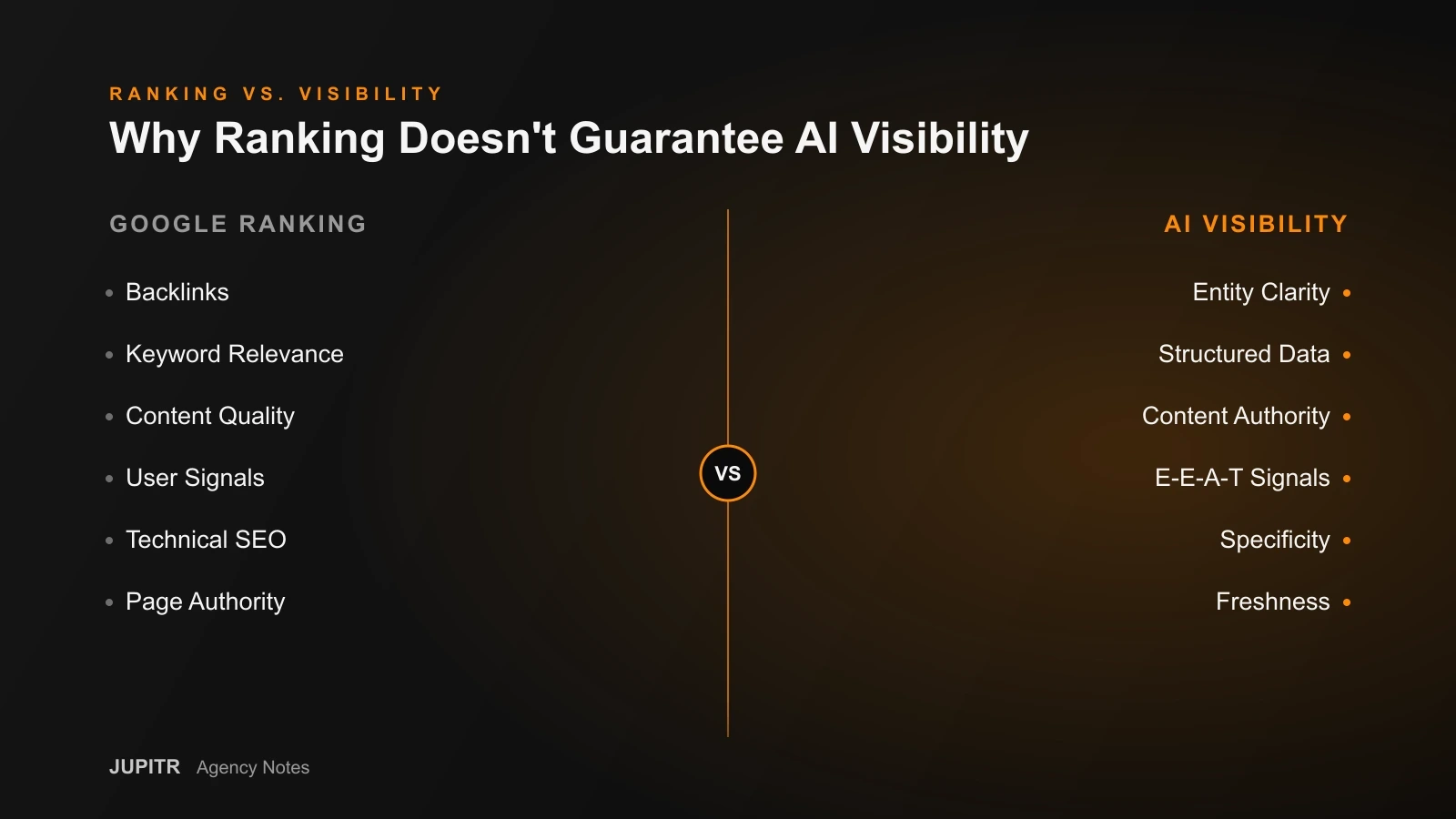
Google's Ranking Algorithm (Traditional SEO)
Google asks: which pages are most relevant and trustworthy for this search?
It measures:
- Backlinks: how many other sites link to you?
- Keyword relevance: does your content match the search?
- Content quality: comprehensive, well-written, helpful?
- User signals: do people click and stay on your page?
- Technical SEO: is your site crawlable and fast?
- Page authority: has this domain earned trust over time?
This system evolved over 25 years. It's well-refined. You can game parts of it (backlinks, keyword optimization) but overall it works.
AI Visibility Ranking (Generative Engine Optimization)
Google's AI Overview (and ChatGPT, Perplexity, Claude, and the rest) asks a different question: which pages are authoritative sources I should cite?
It measures:
- Entity clarity: does this site clearly explain what it is?
- Structured data quality: is the information machine-readable?
- Content authority: does this site have original research or unique expertise?
- Credibility signals: E-E-A-T, Experience, Expertise, Authoritativeness, Trustworthiness
- Specificity: is this source specialized or generalist?
- Freshness: does this site maintain current information?
This is newer. AI systems are still learning what to trust. And they value different signals than Google's ranking algorithm.
Why They Don't Overlap
Here's the uncomfortable part: a site can rank top 10 without being cited by AI.
Example 1: Good Backlinks, Unclear Entity
A site ranks for "headless WordPress" because it has strong backlinks. But the site also does Next.js, Shopify, Laravel, automation, and copywriting.
Google's algorithm says: strong site, relevant keyword, good backlinks, rank it top 10.
AI says: what is this site actually about? It does too many things. I'm not confident it's a headless WordPress specialist. I'll cite someone clearer.
Example 2: High Traffic, Low Authority
A site ranks because it gets lots of clicks and time-on-page, strong user signals. But it's a content farm: lots of pages, thin expertise, no original research.
Google says: people like this site, rank it.
AI says: but why should I cite this site as authoritative? Where's the original research? Where's the expertise?
Example 3: Generalist vs. Specialist
A generalist agency ranks for 50 keywords because it does many things. But AI cites the specialist for each specific query.
Google says: this site is relevant to many queries, rank it high.
AI says: but who is the actual authority for this specific question? Not the generalist. The specialist.
The Practical Impact
This matters because:
- Google AI Overviews are growing. Google is showing AI Overviews for 64% of queries. That number is going up.
- AI-referred traffic converts better. When an AI assistant cites you, the user trusts that recommendation. Conversion rate is 4 to 23x better than organic search traffic.
- You might be invisible where it counts. Top 10 ranking looks good in reports. But if you're not cited by AI, you're missing high-intent traffic.
- Fixing it requires different work. Ranking top 10 doesn't automatically fix AI visibility. You need different optimizations.
It's part of why we've been rebuilding how we deliver this kind of work with agentic AI: auditing and fixing entity clarity, schema, and authority signals at scale used to be too labor-intensive to offer broadly. It isn't anymore.
The Ranking Factors for AI Visibility
If you want to be cited by AI, focus on these signals.
Factor 1: Entity Clarity
Can the AI clearly understand what you do and who you are?
This means:
- A clear mission statement on your homepage
- Specific services (not generic "web development" but "headless WordPress development")
- An about page that explains your niche and expertise
- Consistent messaging across the site
For example, "we do web development, SEO, design, and automation" is too broad. "We specialize in headless WordPress and Next.js development for e-commerce brands" is clear enough that AI confidently cites you.
Factor 2: Structured Data
Is your information machine-readable?
This means:
- Organization schema: correct company information
- Service schema: each service clearly defined
- FAQPage schema: Q&A content properly marked
- Article schema: blog posts with author, date, category
- LocalBusiness schema, if location is relevant
Without proper schema, AI systems struggle to parse who you are and what you offer.
Factor 3: Content Authority
Do you have original research, data, or unique expertise?
This means:
- Case studies with specific results, not anonymized
- Original data you've collected or analyzed
- Expert opinions or frameworks you developed
- Research you conducted yourself
- A unique perspective others don't have
Generic best-practice advice doesn't build authority. Something like "we optimized 50+ Next.js sites, here's what actually works" backed by your own data does.
Factor 4: Experience and Expertise (E-E-A-T)
Why should AI trust you specifically?
This means:
- Team bios showing real experience
- Years in business and depth of work
- Credentials or certifications
- Client testimonials and case studies
- Published work or thought leadership
- Third-party mentions or media coverage
Factor 5: Specificity
Are you a specialist or a generalist?
AI prefers specialists. If you do 10 things equally, you're less likely to be cited than someone who focuses on 2 to 3 things deeply. This is a real trade-off: ranking benefits from broad relevance, AI citation benefits from specialization.
Factor 6: Freshness
Is your site actively maintained?
This means:
- Regular blog updates
- Current publication dates on key pages
- Updated case studies with recent work
- Clear evidence the business is active
- Quick correction of outdated information
Old sites don't get cited. Active sites do.
How to Check Your Own Gap
- Find a keyword you rank for, for example "headless WordPress development."
- Search that keyword on Google and look at the AI Overview, if it appears.
- Check if you're cited. Does the AI Overview mention your site, or does it cite competitors?
- Compare your ranking against your citation. Rank top 10 but not cited? You have a gap. Rank #5 but cited? That's good alignment.
- Run a diagnostic: is your entity clear, is your schema complete, do you have original authority signals, is your site actively maintained?
What to Do About It
If you rank well but get zero AI visibility, here's the priority order.
Priority 1: Clarity (Quick Win)
Make your homepage crystal clear about what you do and who you serve. Not "full-service web development," but "headless WordPress and Next.js development for e-commerce."
Time: 1 to 2 hours. Impact: can immediately improve AI citation odds.
Priority 2: Schema Markup (Technical, High Impact)
Audit and complete your schema markup: is your organization schema correct and complete, is there one detailed service schema per service, is FAQPage schema on your FAQ or blog content, is article schema on all blog posts?
Time: 4 to 8 hours, depending on site size. Impact: AI systems can parse your site better.
Priority 3: Authority Signals (Medium-Term)
Build original authority in your niche: create case studies with real numbers, publish original research or data, document your team's expertise, get mentioned by relevant publications.
Time: ongoing. Impact: the highest long-term value for AI citation.
Priority 4: Freshness (Ongoing)
Maintain your site actively: regular blog updates, current case studies, updated "about" and "team" pages, quick turnaround on outdated content.
Time: 4 to 8 hours per month. Impact: signals ongoing business activity.
The Honest Reality
Ranking and AI visibility require different optimizations.
You can focus on Google ranking and ignore AI, many agencies do. You can focus on AI and ignore Google, fewer agencies do. Or you can optimize for both, which is the best outcome but requires discipline.
The agencies that win in 2026 do both. They rank well on Google and get cited by AI. It requires clarity, data, and maintenance. But the payoff is real: visible in both places means more traffic, more conversions, more credibility.
Tools to Help You Check
- Google Search Console's AI Overviews report (if available in your region) shows if Google's AI is citing you and which keywords trigger citations. Free, if you have GSC access.
- Our audit tool runs a full diagnostic on entity clarity, schema, and authority, with specific recommendations by priority. Free: audit.jupitragency.com.
- Manual testing: search your keywords on Google and look at AI Overview citations, then do the same on ChatGPT, Claude, and Perplexity to see which AI systems cite you and which don't.
Next Steps
If you suspect you have a ranking versus AI visibility gap:
- Audit your entity clarity. Is it immediately obvious what you do and who you serve?
- Check your schema markup. Is it complete and accurate?
- Run the audit tool. It takes about 2 minutes and it's free.
- Test manually. Search your keywords and check the AI Overview citations.
- Prioritize fixes, starting with clarity, then schema, then authority.
If you want help with this, our GEO and AI search optimization service covers exactly this work.
FAQ
If I'm ranking on Google, why do I need AI visibility?
Google rankings are still important, but traditional search volume is projected to decline as queries shift to conversational AI interfaces. Being cited by AI is becoming as important as Google ranking.
Can I improve AI visibility without ranking well?
Theoretically yes, but unlikely. AI systems use Google's index, so if you're not ranking, you're probably not in position to be cited either. Rank first, then optimize for AI citation specifically.
Does schema markup guarantee AI citations?
No. It's necessary but not sufficient. Schema helps AI understand who you are, but you still need authority, clarity, and freshness. Think of schema as table stakes: you need it, but it alone doesn't guarantee citations.
How long does it take to improve AI visibility?
Four to 8 weeks to see measurable improvement if you focus on clarity and schema. Three to 6 months to build real authority signals like case studies and research. Long-term, 6 to 12 months, AI citation compounds as your authority grows.
Should I focus on ranking or AI visibility first?
Start with ranking, since Google SEO is established and valuable. Once you rank, layer in AI-specific optimizations. Both matter, but ranking is the foundation, you need to be discoverable by Google's index before AI systems cite you.
What if my competitors rank lower but get cited more?
They probably have clearer positioning, better schema, or more authority signals. Your ranking is good, their AI positioning is better. You need to catch up on the non-ranking factors, so run both audits.
Does fresh content guarantee AI citation?
No, but it helps. Fresh content signals ongoing business activity. Freshness combined with authority and clarity creates the real conditions for citation. Freshness alone isn't enough.
How do I know if AI systems can even find my site?
Check Google Search Console's AI Overviews report, if available in your region. Search manually for your keywords and look at AI Overview citations. If you rank but aren't cited, your site is discoverable but isn't being selected as a source.